Technologies
Biofloc Technology
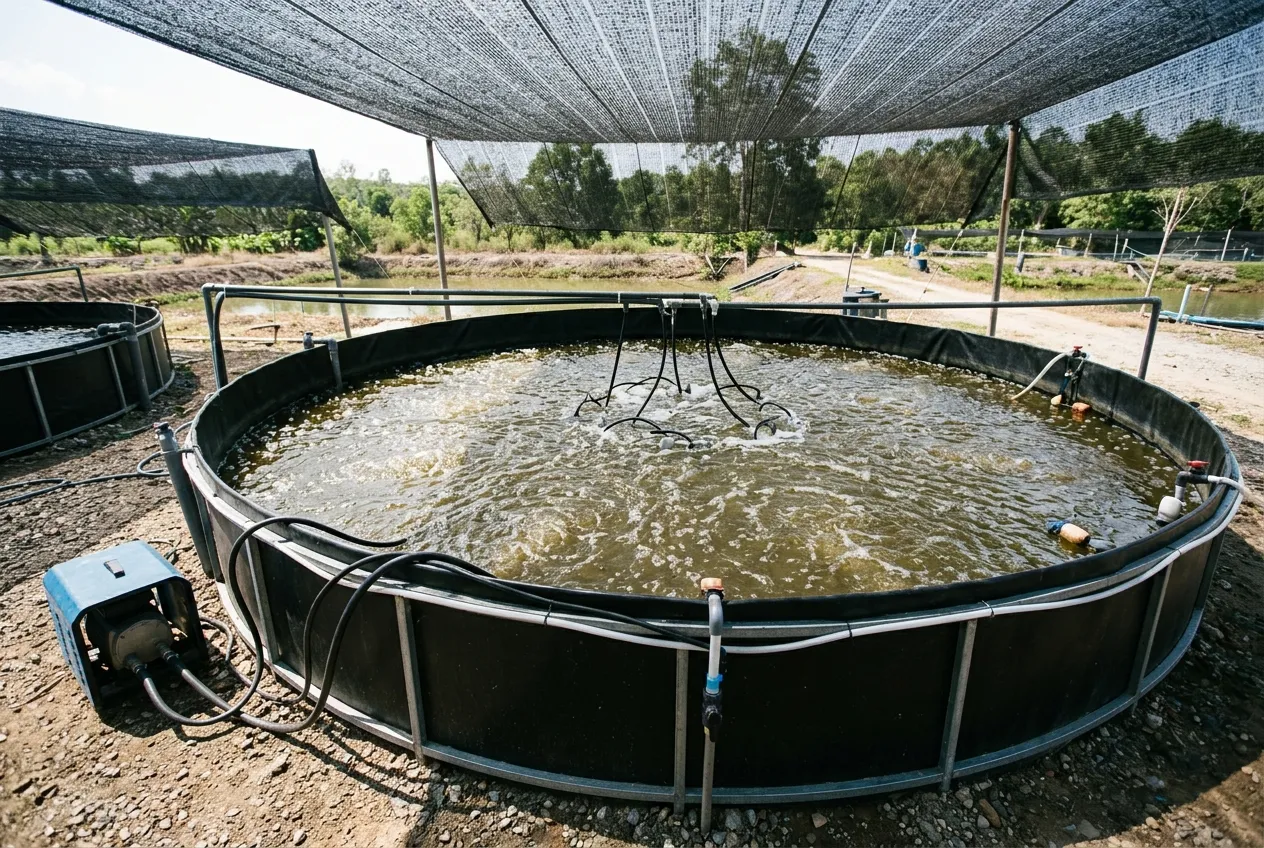
Biofloc technology manages water quality by cultivating a dense community of bacteria, algae, protozoa and organic particles, collectively called floc, within the culture water itself. With intense aeration and a controlled carbon-to-nitrogen ratio, these microbes absorb ammonia and become a supplementary food source for shrimp and some fish.
The principle
Fish and shrimp excrete ammonia. In a biofloc system, operators add a carbohydrate source such as molasses to raise the carbon-to-nitrogen ratio. Heterotrophic bacteria then multiply rapidly, taking up ammonia as they build their own cells. The bacterial biomass clumps into flocs that tilapia and shrimp can eat, recycling nutrients that would otherwise be waste.
What biofloc requires
- Continuous, powerful aeration to keep flocs suspended and supply the high oxygen demand of fish plus microbes.
- Careful control of floc volume; too little leaves ammonia unprocessed, too much consumes oxygen and stresses animals.
- Regular measurement of settleable solids, ammonia, nitrite, pH and alkalinity.
- Lined tanks or ponds with limited water exchange.
- Operators who understand microbial dynamics and respond quickly to shifts.
Biofloc and RAS are different approaches
Both systems reduce water use, but they do so differently. A RAS removes waste from the water through external mechanical and biological filters and keeps the culture water relatively clear. A biofloc system keeps waste in the water and converts it in place using suspended microbes, producing turbid, brown water. RAS offers more precise control; biofloc offers simpler infrastructure but demands constant aeration and microbial management. Some farms combine elements of both.
Species commonly raised in biofloc
Whiteleg shrimp and tilapia are the species most often associated with biofloc because both tolerate turbid water and can feed on flocs. Carps and catfish have been trialled with varying results. Species that need clear water are poorly suited.
Common difficulties
Power failure is the greatest risk, because flocs settle and oxygen falls within minutes. Nitrite spikes during system establishment, excessive floc accumulation, pH drift and foaming are frequent problems. Small backyard biofloc units promoted online often omit these realities; anyone evaluating biofloc should study operating experience over full cycles, not only start-up photographs.