Technologies · Primary subject
Recirculating Aquaculture Systems
A Recirculating Aquaculture System, or RAS, raises fish or shrimp in tanks while continuously treating and reusing most of the water. Instead of flushing waste away with large volumes of new water, a RAS removes solids, converts dissolved toxic nitrogen, manages gases and returns conditioned water to the animals. The result is a high degree of control, a small water footprint and a strong dependence on power, oxygen and skilled operation.
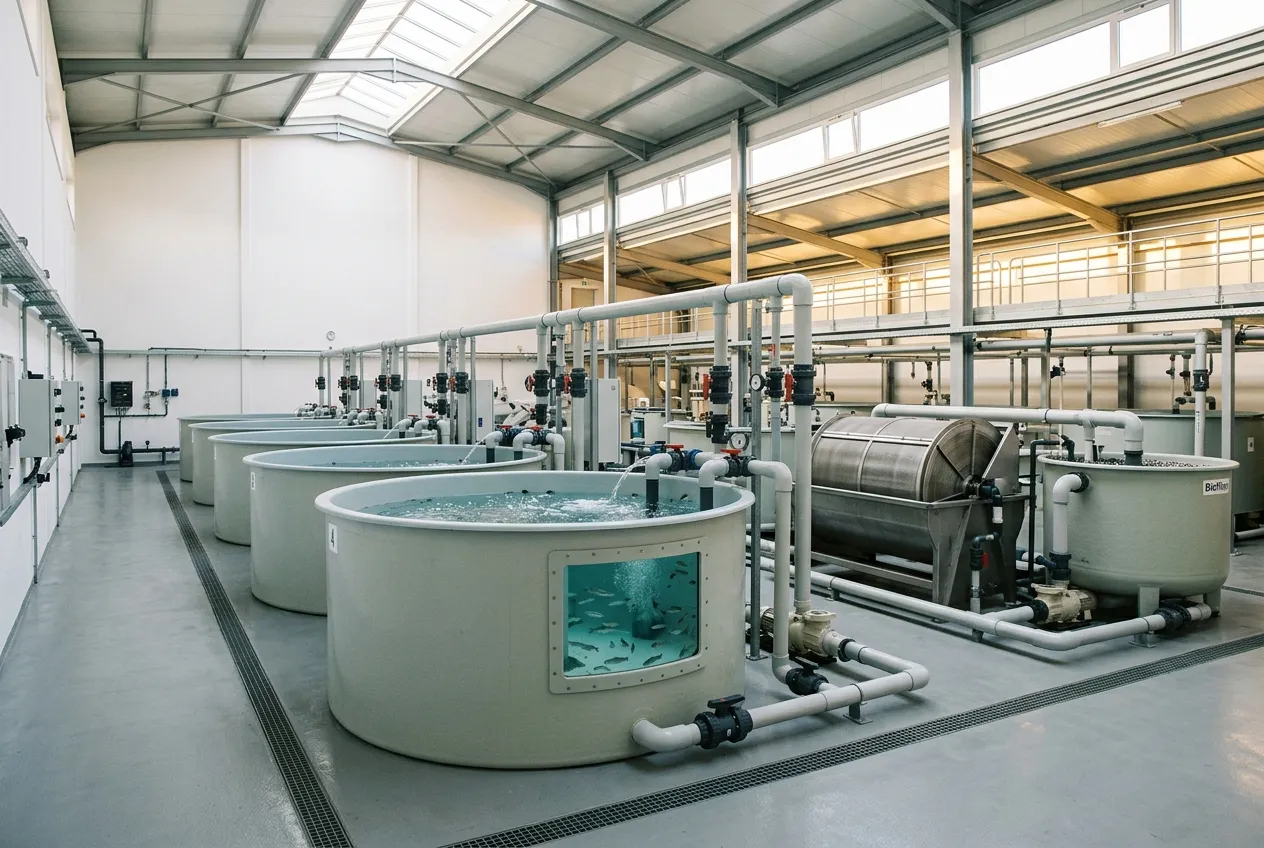
What makes a system a RAS
The defining feature of a RAS is water treatment and reuse. Water leaving the culture tanks passes through a sequence of treatment steps and is pumped back. Daily replacement water is typically a small fraction of the total system volume, used to make up for evaporation, sludge removal and the dilution of substances that treatment cannot remove, such as nitrate.
An indoor building full of tanks is not a RAS unless this treatment loop exists. Equally, a RAS can in principle be built outdoors under shade. Recirculation is a process, not a structure.
The six stages of the water journey
The diagram on this page is a simplified educational schematic. Real systems vary in order, equipment and scale, but almost all include the following stages.
- Culture tanks: fish or shrimp are held at planned densities; feed enters here and waste is produced here.
- Mechanical filtration: drum filters, screens or settling units remove suspended solids such as faeces and uneaten feed before they break down.
- Biological filtration: nitrifying bacteria growing on media convert toxic ammonia to nitrite and then to far less toxic nitrate.
- Gas management: carbon dioxide produced by fish and bacteria is stripped out, and oxygen is added through aeration or pure oxygen.
- Additional conditioning where required: UV or ozone disinfection, pH and alkalinity correction, temperature control and foam fractionation depending on species and water.
- Pumping, return and monitored reuse: treated water is pumped back to the tanks while sensors track oxygen, temperature, pH and flow.
Replacement water and waste are still necessary
A RAS reduces water consumption dramatically but does not eliminate it. Clean replacement water is needed every day. Solids removed by filtration become sludge that must be dewatered and managed, often as a fertiliser input to agriculture where regulations allow. Nitrate accumulates unless water is exchanged or a denitrification step is added. A closed loop with no inputs and no outputs is a misleading picture.
What a RAS requires
- Dependable power: pumps, blowers and oxygen systems must run continuously; an outage of less than an hour can kill a densely stocked tank.
- Oxygen: high densities consume oxygen faster than air alone can supply; many systems rely on pure oxygen and emergency oxygen.
- Trained operators: water chemistry, biofilter management, feeding and alarm response are daily tasks.
- Maintenance: filters, probes, pumps and pipework need scheduled cleaning and replacement.
- Suitable markets: the cost structure of RAS favours species and markets that reward consistency, size and freshness.
What a RAS offers
Control of temperature and water quality allows year-round production independent of season and weather. Biosecurity improves because water entering the system can be treated and the animals are isolated from external pathogens. Water use per kilogram of fish produced is a small fraction of pond culture. Farms can be located closer to markets or on land unsuitable for ponds. Waste is captured rather than discharged, which simplifies responsible management.
Species commonly considered for RAS
Species that tolerate high densities, accept formulated feed and command stable prices tend to be considered for recirculation. Internationally these include salmonids, tilapia, catfish, barramundi and, increasingly, whiteleg shrimp. In India, tilapia, pangasius, catfish and shrimp are discussed most often. Species profiles on this portal explain considerations rather than prescribing stocking choices.
Is RAS the right choice?
RAS makes most sense where water is scarce or expensive, where biosecurity is critical, where the market rewards control and where power, oxygen supply and technical skills are reliably available. Where land and water are plentiful and markets are price-sensitive, an improved pond may deliver more with less risk. The comparison page sets these systems side by side.